
Table of Contents
- Step 1: Establish Clear Waste Management Guidelines
- Step 2: Create a Community Waste Management Policy Template
- Step 3: Implement HOA Trash Container Rules
- Step 4: Schedule Professional Trash Bin Cleaning Services
- Step 5: Manage Bulk Trash Disposal Guidelines
- Step 6: Enforce Compliance and Resident Education
- Step 7: Review and Optimize Your Trash Management Plan
- Frequently Asked Questions
Last Updated: October 7, 2026
Step 1: Establish Clear Waste Management Guidelines
Effective HOA trash management starts with setting expectations: residents need to know exactly when trash goes out, where it goes, and when it comes back inside.
Define specific set-out and retrieval times.
Specify placement rules: bins at the curb but never blocking sidewalks, mailboxes, or sight lines, and stored in designated areas (garages, side yards, or behind screening) when not in use.
Document these guidelines in writing. A simple one-page handout works. Include:
- Exact set-out dates and times
- Retrieval deadlines
- Approved bin locations
- Consequences for violations
New residents often miss these details. Send guidelines when they move in, and include a reminder in your community newsletter quarterly. Small reminders prevent most problems before they start.
Step 2: Create a Community Waste Management Policy Template
A written policy protects your HOA and gives you enforcement teeth when residents push back or claim they didn’t know the rules. The strongest policies pair resident-facing rules with a vendor contract section, because the hauler agreement determines whether your rules are enforceable on the ground.
The resident-facing half of the template
Your policy template should outline recycling requirements for your area. Check what your local hauler accepts, some take glass and metal, others don’t, and make clear what goes where. Contaminated bins cost money and create operational headaches.
Document enforcement step by step: a friendly reminder letter, then a formal violation notice with a 7-14 day correction timeline, then fines, liens, or mandatory service requirements if violations persist.
A workable template includes these sections, in this order:
- Purpose and scope, one paragraph tying trash rules to property values, pest control, and community health.
- Definitions, “bulk item,” “acceptable recyclable,” “designated storage area,” “collection day.”
- Set-out and retrieval windows, exact times, not “evening” or “morning.”
- Container standards, size, lid requirement, labeling, and approved storage locations.
- Recycling and contamination rules, what the hauler accepts, and what triggers a rejected load.
- Bulk and special waste, separate schedule, separate area, separate rules for hazardous items.
- Violation ladder, reminder, formal notice, fine, and the appeal path.
- Vendor service standards, the hauler’s obligations, pulled directly from the contract.
The vendor-contract half most HOAs skip
Before you finalize the policy, read your hauling contract and pull the service standards into the template. If the contract doesn’t specify them, that’s your next negotiation. A vendor contract checklist for HOA boards typically covers:
- Missed-pickup credits. What happens when the hauler skips a street? A credit clause gives you leverage and a paper trail.
- Contamination thresholds. At what contamination level does the hauler reject a recycling load, and who pays the re-dump fee?
- Bulk pickup frequency. Is it included, or billed per item? Get it in writing.
- Holiday schedule. Which holidays shift pickup, and how much notice does the hauler owe you?
- Escalation clause. How much can the rate rise per year, and what triggers a mid-term increase?
- Term and termination. Multi-year terms with auto-renewal are common; know your exit window.
Boards that negotiate these terms up front spend less time chasing missed pickups. The contract is the enforcement backbone; the policy is its resident-facing summary.
Keep the template flexible. Set-out times may not work in winter, and bulk disposal may need its own schedule, a modifiable template beats rewriting policy from scratch.
Add language about HOA trash container rules and how they connect to your overall community standards, trash management is about property values and community pride, not just waste.
Review the vendor contract and the resident policy on the same calendar cycle. When the contract renews, the policy usually needs a refresh too, new pickup days, new recycling rules, or new bulk schedules all flow downhill to residents.
Step 3: Implement HOA Trash Container Rules
Choosing between curbside collection and centralized bin systems shapes everything about your waste management. Each approach has trade-offs.
Curbside collection is convenient but visible: bins sit at curb level where neighbors see them.
Centralized bin systems suit larger communities and townhome complexes. Residents walk bins to a screened enclosure or designated area, keeping individual curbs cleaner but requiring more effort and coordination.
Establish enclosure and concealment standards that match your layout.
Overflowing bins create liability issues. Spilled trash attracts pests, creates sanitation problems, and signals poor management. Enforce retrieval deadlines strictly, this is non-negotiable for community health.
Step 4: Schedule Professional Trash Bin Cleaning Services
Clean bins matter more than most HOAs realize. Dirty bins breed bacteria, insects, and complaints, residents notice odor before anything else about your waste management.
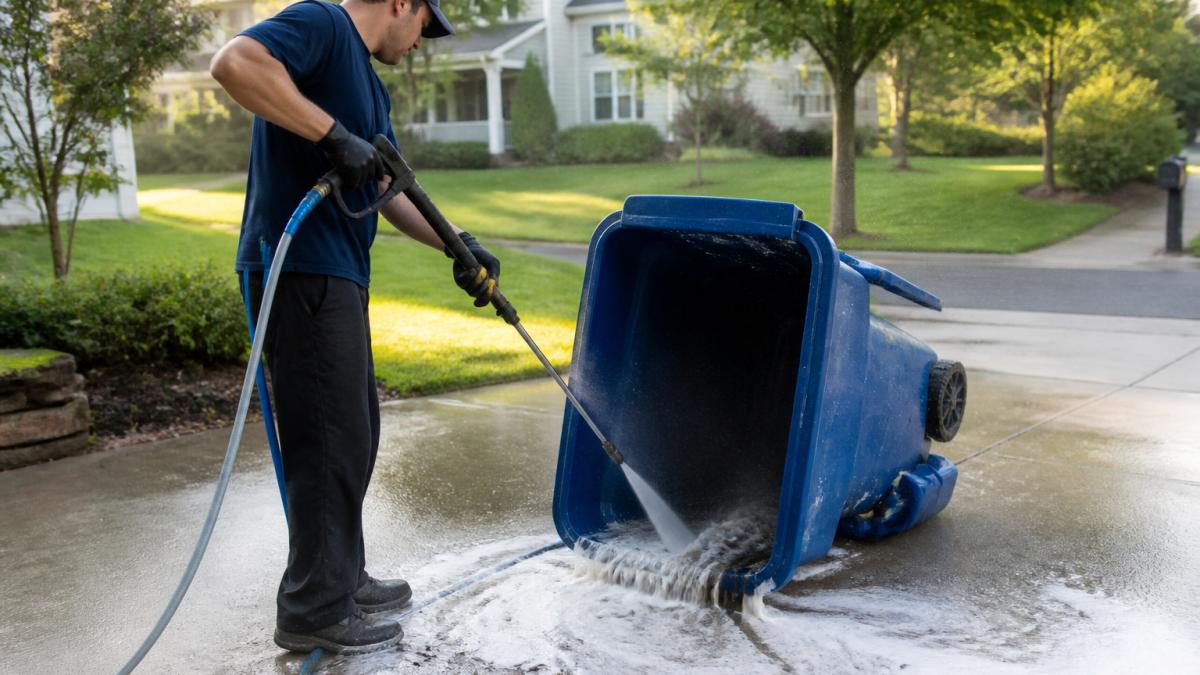
Select cleaning frequency based on climate and community size.
Choose providers who use hot water and proper sanitation methods. At Chester County Clean Cans, we use 200° hot water to eliminate bacteria, odors, and grime, heat that kills pathogens garden hoses can’t reach, plus eco-friendly methods that protect landscaping and storm drains.
Monitor results after service begins. Ask residents to report lingering smells or pest issues, and track bins needing extra attention. Professional cleaning plus retrieval-deadline enforcement usually solves 80% of odor complaints.
Step 5: Manage Bulk Trash Disposal Guidelines
Bulk items, furniture, appliances, yard waste, create chaos without a plan. Residents dump them in regular bins, causing overflow and collection problems.
Coordinate bulk collection with your hauler. Most communities schedule pickups quarterly or semi-annually.
Prevent illegal dumping and overflow by designating a specific bulk-item area, never mixed with regular trash.
Set firm rules about what doesn’t go in bulk collection. Hazardous waste, paint, chemicals, batteries, needs separate disposal.
Bulk trash management is where most HOAs lose control. A clear schedule and designated area solve 90% of the problem. Residents respect structure when they understand the rules.
Step 6: Enforce Compliance and Resident Education
Rules mean nothing without enforcement. Inconsistent enforcement creates resentment and undermines your entire waste management system.
Send violation notices for bins out too early, left out too long, improperly placed, or overflowing. Keep them professional and specific, “Your trash bin remained at curb for three days past collection.
Educate on waste etiquette regularly, many violations come from misunderstanding, not malice.
Use your newsletter to reinforce good practices, highlight seasonal adjustments, and celebrate compliance: “Thanks to residents’ attention to bin placement, our community maintained its cleanliness standards this quarter.”
Make education ongoing. New residents arrive constantly, so a welcome packet with waste management guidelines should be standard, and some communities add a seasonal reminder.
Step 7: Review and Optimize Your Trash Management Plan
Your waste management system isn’t static. Regular review keeps it working and catches problems early. This is where most HOAs stop at “walk the community and see how it looks”, and where the biggest opportunity sits, because modern waste management is measurable.
Track the metrics that actually matter
Perform waste audits to track compliance metrics. Walk your community monthly and note which residents follow guidelines and which don’t. Track patterns: do violations cluster in certain areas? Do they spike at certain times? Data reveals what’s working and what needs adjustment.
Go beyond the walk-through and record a small set of numbers each month:
- Set-out compliance rate, percentage of households that placed bins within the approved window.
- Retrieval compliance rate, percentage retrieved by the deadline.
- Contamination rate, how often the hauler flags a recycling load, and why.
- Missed pickups, count per month, by street or route.
- Odor and pest complaints, count per month, by location.
- Bulk pickup volume, items collected per scheduled event.
Six numbers, tracked monthly, will tell you more than any single walk-through. They also give your board something concrete to report at the annual meeting.
Use technology to replace manual enforcement
Most HOA boards still enforce trash rules by driving around and writing notes. That works, but it doesn’t scale, and it produces no data. A few low-friction tools change the picture:
- Automated reporting apps. Residents photograph a violation or a missed pickup through a community app; the report routes to the board or manager with a timestamp and location. This replaces the “I told the board and nothing happened” problem with a trackable ticket.
- Smart bins and fill-level sensors. For centralized bin systems, fill-level sensors notify the hauler when a bin is near capacity, which reduces overflow and unnecessary pickups. Some haulers offer this as an add-on; ask during contract renewal.
- Camera coverage at enclosures. A single camera at a centralized enclosure deters illegal dumping and provides evidence when a violation escalates.
- Digital violation logs. A shared spreadsheet or property-management platform beats a paper file when a dispute reaches the board or an attorney.
None of these require a large budget. The reporting app and the violation log are usually the highest-return first steps because they generate the data the rest of your review depends on.
Report sustainability metrics residents can see
Sustainability reporting is the angle most HOA waste plans miss entirely. You don’t need a formal ESG program, you need three numbers, reported quarterly:
- Diversion rate, the share of waste diverted from landfill through recycling and composting. Your hauler can usually provide tonnage by stream.
- Recycling tonnage, total pounds or tons recycled per quarter.
- Contamination trend, whether rejected loads are rising or falling.
Publishing these in the newsletter does two things: it gives residents a reason to care about contamination rules, and it gives the board a defensible story about community stewardship. A common pattern is to pair the numbers with a short note, “Contamination dropped after the new labeling, keep it up”, so the data reinforces the behavior you want.
Adjust policies based on evidence, not anecdote
Adjust policies based on resident feedback and the metrics above.
Document everything. Keep records of violation notices, compliance rates, and service schedules. This protects your HOA if disputes arise and shows your board is managing the community professionally.
Review your professional trash bin cleaning services annually against the same metrics. Are residents reporting fewer odor problems? Are pest complaints down?
A trash plan you can’t measure is a trash plan you can’t improve. Pick six compliance numbers, add one reporting tool, and publish a quarterly diversion figure. That combination puts your HOA ahead of nearly every community still enforcing by clipboard.
Frequently Asked Questions
What are the most effective ways to enforce HOA trash container rules?
Effective enforcement starts with clear written policies distributed to all residents. Document violations with photos and dates, then issue written warning notices before fines. Hold monthly HOA board meetings to review compliance trends. Engage residents through newsletters and community meetings to explain why rules matter for property values and pest prevention. Consistent, fair enforcement builds respect for the policy. Consider offering professional trash bin cleaning services to eliminate odor-related violations and demonstrate the HOA’s commitment to community standards.
How often should community trash bins be professionally cleaned?
Professional cleaning frequency depends on climate, bin usage, and odor issues. In warm months when bacteria and pests thrive, monthly cleaning is ideal. Quarterly cleaning works for moderate climates and lighter usage. High-traffic communities or those with persistent odor complaints benefit from bi-weekly service. A one-time deep clean can address severe maggot or grime buildup before establishing a regular schedule. Professional services use 200° hot water to sanitize and deodorize, eliminating bacteria at the source rather than surface cleaning alone.
What should a community waste management policy template include?
A solid template covers set-out and retrieval times (typically 24 hours before and after collection), bin placement rules (distance from property lines, visibility screens), recycling guidelines, hazardous waste disposal protocols, bulk item procedures, enforcement procedures, and violation penalties. Include definitions of common area maintenance responsibilities, specify who manages contractor relationships, and outline the process for resident complaints. Add a section on accessibility requirements to ensure elderly or disabled residents can comply. Make the policy specific to your community’s collection schedule and bin types.
How can an HOA board improve community recycling participation?
Start with resident education, many don’t understand what goes in recycling or why it matters. Provide clear, visual signage on bins and in common areas. Host a community meeting to explain local recycling guidelines and contamination issues. Offer incentives such as monthly recognition for buildings with perfect compliance. Conduct a waste audit to identify contamination problems, then address them directly with residents. Consider professional bin cleaning services as part of your recycling program, since clean bins encourage participation. Track diversion rates quarterly and share results with residents to show progress.