
Table of Contents
- Is Professional Bin Cleaning Worth It? The Honest Answer
- How Professional Bin Cleaning Works, Start to Finish
- Professional Bin Cleaning vs DIY: A Like-for-Like Comparison
- Trash Can Cleaning Service Benefits That Go Beyond Smell
- How Often to Clean Trash Bins (and What Changes the Schedule)
- The Real Monthly Cost of Bin Cleaning and How to Judge It
- Wastewater, Eco-Friendly Detergents, and What Happens to the Runoff
- Conclusion: Matching the Service to Your Household
- Frequently Asked Questions
Last Updated: October 9, 2026
Is Professional Bin Cleaning Worth It? The Honest Answer
If you’re asking whether professional bin cleaning is worth it, the honest answer is: it depends less on the service and more on your household.
Here’s the part most people miss. The real question isn’t “can I clean this myself?” It’s “will I actually do it, and will my method kill what’s growing in there?” Most of us spray a hose, splash some dish soap, and call it done.
At Chester County Clean Cans, we run into this every week: bins that look fine on the outside but reek the moment the lid opens.
How Professional Bin Cleaning Works, Start to Finish
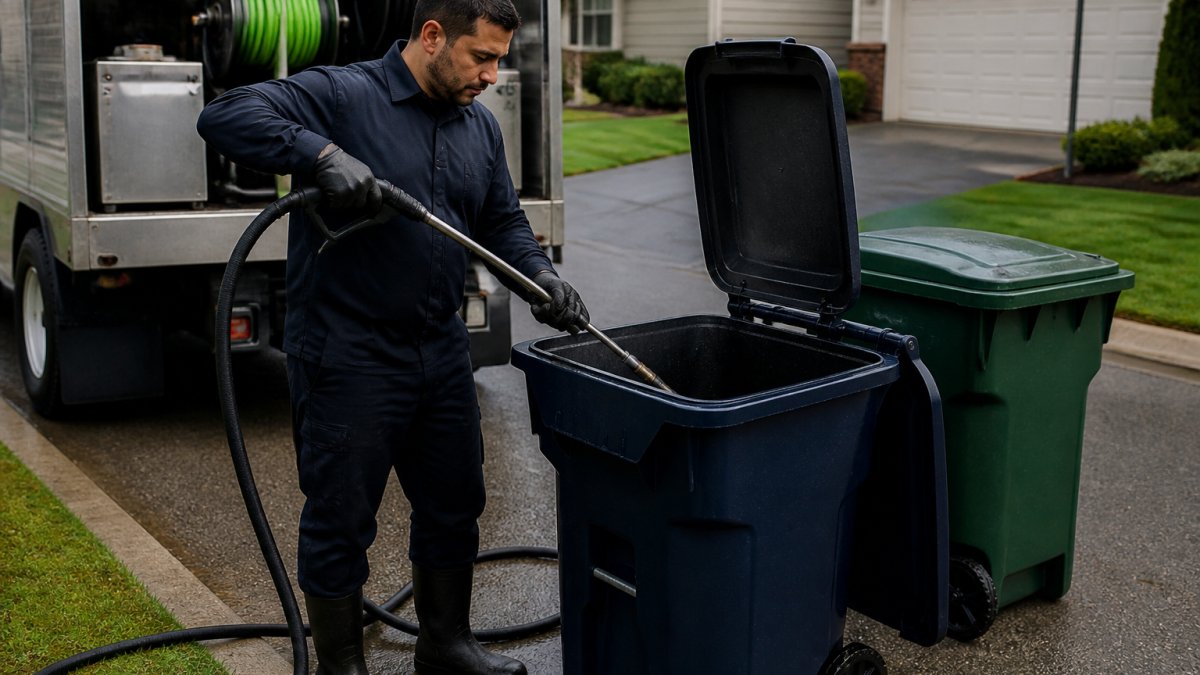
Professional bin cleaning is a curbside service where a truck-mounted unit sprays your empty bin with high-pressure hot water, sanitizes it, and leaves it to dry, usually within a day of your regular trash pickup. You don’t need to be home.
What Happens Curbside in Those 10 Minutes
The process is quick and hands-off. You leave your bin at the curb after pickup, and the crew handles the rest.
- Empty and inspect. The bin must be empty. Crews can’t clean around a full bag, so most services align their schedule to your pickup day.
- Scrape and rinse. Loose debris, stuck food residue, and grease get knocked out first.
- High-pressure hot water wash. This is the core step. Hot water under pressure lifts the grime film that a garden hose can’t.
How to Evaluate Sanitation Claims Before You Book
“Sanitized” gets thrown around loosely in this industry. Ask what temperature the water hits, whether the runoff is captured or left in your yard, and what cleaning solution is used. If a provider can’t answer those three questions, that’s your answer.
Ask whether the crew cleans the lid interior and the underside of the bin. Those two spots hold the worst odor, and plenty of services skip them because it’s faster not to.
Professional Bin Cleaning vs DIY: A Like-for-Like Comparison
Doing it yourself is genuinely cheaper on paper. What that comparison leaves out is your time, your water use, and how well a hose actually disinfects.
| Factor | DIY Cleaning | Professional Bin Cleaning |
|---|---|---|
| Upfront cost | Low (soap, brush, hose) | Per-service fee, varies by plan |
| Time per bin | 20-40 minutes | Zero; you leave it curbside |
| Water temperature | Cold, from a hose | Hot water under pressure |
| Odor removal | Temporary, surface-level | Deep clean, sanitized |
| Wastewater | Runs into your yard or street | Captured and hauled away |
| Pest and maggot control | Partial | Thorough |
A common mistake is judging DIY by the good outcome on a lightly used bin. The gap shows up on the nasty ones: summer heat, diaper pails, pet waste, and anything that sat through a leaking garbage bag.
Trash Can Cleaning Service Benefits That Go Beyond Smell
Odor is the benefit everyone mentions. The ones that change your decision are quieter, and they depend on your household. Here’s how to tell which benefits actually apply to you.
Sanitation: know what the words mean
“Sanitized” and “disinfected” aren’t interchangeable, and the difference matters when you’re paying for it.
- Cleaning removes visible grime, residue, and some surface microbes. It’s what a hose and brush do.
- Sanitizing reduces bacteria to a level considered safe by a public health standard. It usually requires a product applied at a specific concentration and contact time.
- Disinfecting kills or inactivates a much higher percentage of pathogens, and it also depends on label directions being followed exactly.
A hot-water wash plus detergent cleans and can sanitize. Whether it disinfects depends on temperature, dwell time, and the product used. If a provider claims disinfection, ask which product and whether the label directions for that use are being followed. That’s a fair question, not a hostile one.
Pest control: why a clean bin stops being a food source
Flies, maggots, and raccoons are attracted to residue, not to the bin itself. Remove the residue and you remove the invitation. This is the only durable fix, because traps and sprays treat the symptom while the food source stays.
If you’ve had maggots, the cycle matters: eggs and larvae survive a quick rinse in the crevices and under the rim. A hot-water wash reaches those areas. A garden hose usually doesn’t.
Household hygiene: the zone you don’t think about
Bins sit near garage entries, back doors, and sometimes play areas. A bin that stays clean keeps that transition zone from becoming a reservoir for the bacteria and pests that feed on food waste. For households with crawling toddlers or pets that patrol the garage, that’s a real benefit, not a marketing line.
Time: the benefit that scales with your life
Twenty to forty minutes per bin, times your bins, times how often you’d actually do it. For most people the honest number is higher than they think, because the cleanings they skip don’t show up in the estimate.
Who gets the most value
Match the service to your situation rather than to a blanket verdict:
- High value: young kids in diapers, pets with waste in the bin, food scraps, hot and humid summers, prior pest problems, or a bin that sits in direct sun.
- Moderate value: a busy household with standard trash and mild seasons that wants consistency without the chore.
- Low value: a low-waste household with mild weather and a bin that rarely holds food residue. A quarterly or one-time clean may be all you need.
What cleaning does not fix
Set expectations before you buy:
- Stains. Years of residue can discolor plastic permanently. Cleaning removes the source, not always the mark.
- Damaged bins. Cracks, warped lids, and broken wheels aren’t repaired by cleaning.
- Persistent odor. If the smell comes from a cracked base or a soaked liner, a wash helps but may not eliminate it.
If your main problem is pests, ask the provider how they handle the rim, lid interior, and underside. Those are the spots where residue hides and where a rushed job shows.
How Often to Clean Trash Bins (and What Changes the Schedule)
Most households land on a four-week schedule, but that’s a starting point, not a rule. How often you should clean trash bins depends on what you’re throwing away and where you live.
Bump up the frequency if any of these apply:
- You have young kids in diapers or pets with waste in the bin
- Your bin sits in direct summer sun
- You’ve had maggots, flies, or raccoons before
A quarterly plan can work for a small household with light trash and mild seasons. A one-time cleaning makes sense if you just inherited a filthy bin from a previous owner or tenant.
Skipping a deep clean after a maggot infestation rarely works. The eggs and residue survive a quick rinse, and the problem returns within weeks. You need the hot-water wash to break the cycle.
The Real Monthly Cost of Bin Cleaning and How to Judge It
Most articles on this topic wave at price and move on. That’s not useful. What you actually need is a like-for-like comparison with stated assumptions, so you can plug in your own numbers and see whether a service beats doing it yourself.
Build the DIY side honestly
DIY isn’t free. It just spreads the cost out where you don’t notice it. To compare fairly, add up:
- Water. A garden hose runs roughly 8-12 gallons per minute. A 20-minute scrub per bin is 160-240 gallons. Check your utility’s rate per 1,000 gallons and multiply.
- Supplies. Degreaser or enzyme cleaner, a stiff brush, a scrub mitt, and gloves. Brushes wear out; budget for replacement every season or two.
- Equipment wear. If you use a pressure washer, factor in the machine’s cost spread over its life, plus gas or electricity.
Build the service side the same way
A recurring plan is usually quoted per bin, per visit, billed monthly or quarterly. To compare apples to apples, convert it to an annual figure:
- Monthly service on two bins = 24 cleanings per year.
- Quarterly service on two bins = 8 cleanings per year.
- One-time cleaning = 2 cleanings, once.
Then divide the annual plan total by the number of cleanings to get your effective per-clean cost. That’s the number to stack against your DIY total.
The decision rule that actually works
Run both totals. Then ask three questions:
- Is the gap small enough that consistency wins? If DIY and the service land in the same neighborhood, the service usually wins because it happens whether you feel like it or not.
- Does your DIY plan survive August? The month you most need a clean bin is the month you least want to stand in the heat with a hose.
- What’s the cost of getting it wrong? Maggots, raccoons, and persistent odor have their own cleanup costs, and a failed DIY attempt is money spent twice.
Don’t compare a service fee to “free.” Compare it to the real DIY total: water, supplies, equipment, time, and the cleanings you skip. That’s the only comparison that tells you anything.
What changes the number
- Number of bins. Trash, recycling, and yard waste are usually priced separately.
- Frequency. Monthly costs more per year than quarterly but less per cleaning.
- Route density. Providers with many customers on your street can often offer better rates than one-off trips.
Ask for the annual total, not the monthly teaser. That’s the figure you compare.
Wastewater, Eco-Friendly Detergents, and What Happens to the Runoff
This is the question we get most from homeowners, and it’s a fair one.
A proper curbside service captures the wastewater instead of letting it run. The bin gets washed over a containment system, the dirty water is collected, and it’s disposed of correctly rather than dumped at the curb.
If runoff is your main concern, ask any provider directly: “Where does the water go?” The answer tells you everything about how they operate.
Conclusion: Matching the Service to Your Household
So, is professional bin cleaning worth it? For households with kids, pets, hot summers, or a recurring pest problem, yes.
Chester County Clean Cans makes the decision easy. We’re also proud to support local youth sports: customers who select WC Mens Soccer at checkout send 20% of sales to the West Chester Henderson Men’s Soccer Team.
Get a quote today and find the plan that fits your household.
Frequently Asked Questions
Is professional bin cleaning worth it?
It depends on what you are comparing it against. If you clean your trash can yourself every few weeks with a hose, scrubbing brush, and disinfectant, the money you save is real but so is the time and the mess. If you have never cleaned your bin, or you are dealing with maggots, raccoons, or a garage that smells like garbage, a recurring bin cleaning service solves a problem that DIY rarely fixes completely. Look at the cost per cleaning against how often you would realistically do it yourself.
How often should trash bins be professionally cleaned?
Most households do well on a four-week schedule during warm months and every eight to twelve weeks in cooler weather. Homes with young children, pets, or frequent food waste may want monthly service year-round. If you have had a maggot or rodent problem, start with a one-time deep clean and then move to a recurring plan so the problem does not return. Your service provider can adjust frequency based on bin condition and climate.
Is professional bin cleaning better than cleaning bins yourself?
For surface grime, DIY can work. For the deep contamination that causes lingering odors, professional cleaning has the edge because it uses high-pressure hot water and sanitizing solutions that reach the bottom and corners of the bin where a garden hose cannot. It also disposes of the wastewater properly instead of letting it run into your yard or storm drain. The trade-off is cost: DIY is nearly free in money but costs you time and effort each cycle.
Does professional bin cleaning remove odors?
Yes, when it is done correctly. Odor comes from bacteria breaking down food residue, grease, and liquid that has leaked from garbage bags. A hot-water clean with a sanitizing solution kills those bacteria and flushes out the residue they feed on. Deodorizing without cleaning does not last. If your bin still smells after a professional cleaning, the source is usually a crack or a lid gap that traps liquid, and the provider should point that out.