
Table of Contents
- Why Residential Trash Bin Sanitizing Services Solve a Problem You Can’t Hose Away
- What Actually Builds Up in a Bin Between Pickups
- What a Residential Trash Bin Sanitizing Service Includes
- How Curbside Trash Bin Cleaning Works, Step by Step
- How Often to Clean Trash Bins: A Simple Schedule That Works
- Eco-Friendly Trash Can Cleaning: Where the Water and Chemicals Go
- Trash Bin Deodorizing Service: How Odors and Pests Are Handled
- Pricing, Plans, and What Drives the Cost of Bin Cleaning
- How to Choose a Local Trash Bin Sanitizing Provider
- Conclusion: A Cleaner Bin in One Curbside Visit
- Frequently Asked Questions
Last Updated: October 12, 2026
Why Residential Trash Bin Sanitizing Services Solve a Problem You Can’t Hose Away
Residential trash bin sanitizing services clean, disinfect, and deodorize the wheeled carts you leave at the curb, using pressurized hot water and specialized equipment rather than a garden hose.
Here’s what most homeowners get wrong: a smelly bin isn’t cosmetic. A bin that stays damp and coated in organic residue invites flies, maggots, and rodents, a few feet from your kitchen door.
Below, we’ll walk through what actually builds up between pickups, what a professional cleaning involves, how often to schedule it, and what drives the cost. U.S. Environmental Protection Agency guidance on managing household waste offers useful context on why food-contaminated containers attract pests so reliably.
What Actually Builds Up in a Bin Between Pickups
The visible trash leaves on pickup day. The residue doesn’t.
What stays behind is a layered film of food liquid, grease, and fine organic matter pressed into the plastic.
Bins with yard waste or food scraps are the worst offenders, but a recycling bin isn’t innocent either: one unrinsed jar leaves a sugary film that attracts ants. Once that layer sets, hosing it out spreads the problem across your driveway instead of solving it.
What a Residential Trash Bin Sanitizing Service Includes
A full service visit goes well beyond a rinse, typically covering:
- Full interior wash using pressurized hot water to lift caked-on residue from the walls and floor
- Exterior cleaning, including the lid, sides, and wheel area where grime collects
- Sanitizing with a disinfectant to reduce bacteria and knock down the source of odors
- Deodorizing so the bin smells neutral, not perfumed
The difference between a hose and a professional service isn’t water pressure alone. It’s what happens to the dirty water afterward. A service that captures and disposes of runoff properly protects your yard, your driveway, and the storm drain at the end of your street.
How Curbside Trash Bin Cleaning Works, Step by Step
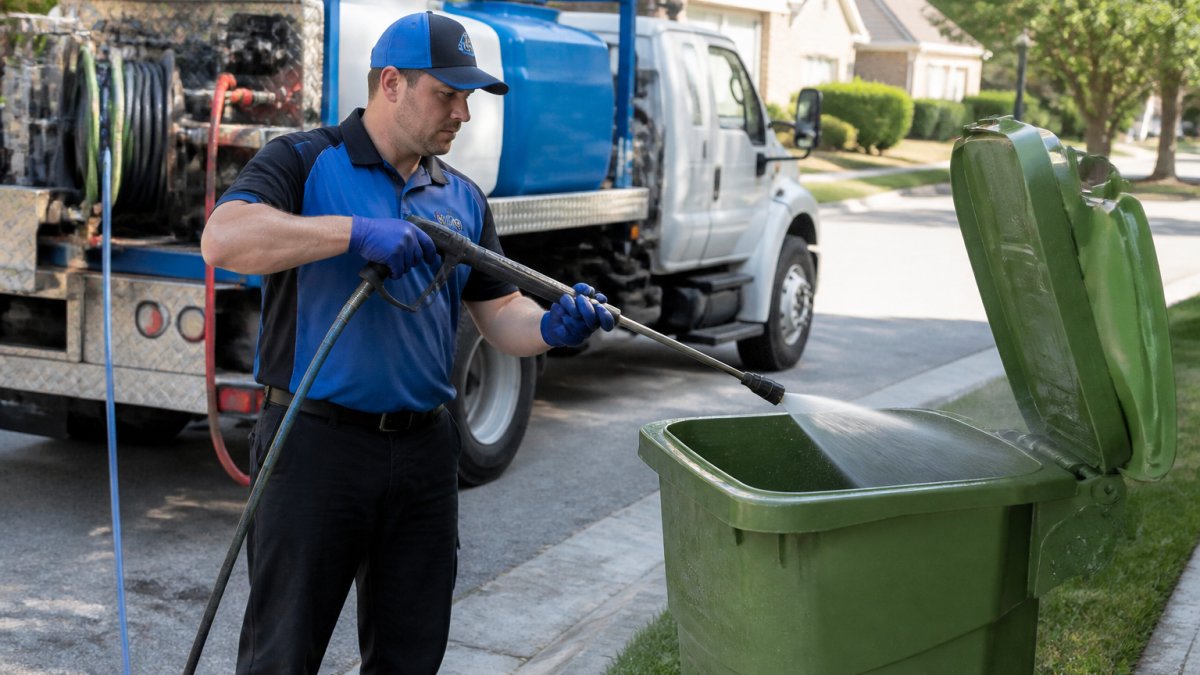
The process is designed so you barely lift a finger. Here’s how a typical curbside visit runs.
- You leave your bins curbside after pickup. No need to be home.
- The technician arrives and inspects the bin, noting heavy buildup or pest activity.
- The bin is lifted and washed with pressurized hot water, inside and out.
- A disinfectant is applied to sanitize surfaces and reduce germs.
- The bin is deodorized to neutralize lingering odors.
- Wastewater is captured and hauled away rather than dumped on your property.
- The bin is left clean and dry at the curb for you to bring in.
Chester County Clean Cans completes each visit within 24 hours of pickup, so your bins are back in service fast.
What You Need to Do Before Service Day
Almost nothing. Set your bins out as usual on collection day and leave them at the curb. Make sure the lids are accessible and the bins aren’t blocked by a parked car, and mention any severe maggot activity when you book. No pre-rinsing or emptying needed.
How Often to Clean Trash Bins: A Simple Schedule That Works
There’s no universal answer to “how often”, the right cadence depends on what goes in your bin, who lives in your house, and the weather. Here’s how to reason through it.
The Four Factors That Set Your Cadence
1. What you throw away. A household that cooks most nights and scrapes plates into the bin builds residue far faster than one that composts or eats out.
2. Household size. More people means more food packaging, liquid waste, and moisture that drives bacterial growth.
3. Climate and season. Heat is the biggest accelerator.
4. Pest history. If you’ve had flies, maggots, or rodents around your bins before, you’re not starting from zero.
A Practical Starting Schedule
| Household Situation | Recommended Frequency | Why |
|---|---|---|
| Family with food scraps, warm and humid months | Monthly | Fast odor buildup, fly and maggot pressure |
| Family with food scraps, cool months | Every 2-3 months | Slower fermentation, less pest activity |
| Average household, year-round | Quarterly | Keeps residue from setting into scratches and seams |
| Recycling bin only, rinsed containers | Every 3-4 months | Prevents sticky film and ant trails |
| Recycling bin with unrinsed containers | Monthly | Sugary residue attracts ants and fruit flies |
| Yard waste bin | Seasonal, as needed | Grass clippings and leaves ferment and mold quickly |
| One-time deep clean | Once | Best for inherited, neglected, or post-renovation bins |
How to Tell You Got It Wrong
Your bin will tell you before your nose does. Watch for these signals:
- A sour smell that lingers after pickup day, not just before it
- Visible dark residue along the rim, lid hinge, or bottom corner
- Small flies hovering when you open the lid
- Moisture pooling in the bottom of the bin
If you see any of these, move up one step on the frequency ladder; go a full season with none and you can safely stretch the interval.
The cheapest cadence is the one that prevents problems rather than reacting to them. A monthly visit in July costs less than a deep clean of a maggot-infested bin in August, and it keeps your garage and kitchen entry from smelling like a dumpster in between.
If you’re unsure where to start, book a one-time cleaning and watch how the bin holds up over the following weeks. That real-world result tells you more than any rule of thumb.
Eco-Friendly Trash Can Cleaning: Where the Water and Chemicals Go
Eco-friendly trash can cleaning means the wash water and any disinfectant used are handled responsibly, not flushed into your yard or the storm drain.
A responsible service captures the wastewater at the source and disposes of it properly. If a provider can’t explain where their runoff goes, that’s your answer. U.S. EPA information on stormwater runoff and its effects explains why untreated runoff is a real concern, not a marketing talking point.
Trash Bin Deodorizing Service: How Odors and Pests Are Handled
Deodorizing isn’t about covering a smell with something stronger. It’s about removing the source.
The odor in a bin comes from bacteria breaking down organic residue; kill the residue and the smell goes with it.
Pest control works the same way. Flies, maggots, and rodents are drawn to food residue and moisture. Remove both and you remove the invitation. A bin that stays clean and dry between pickups gives pests nowhere to settle.
Pricing, Plans, and What Drives the Cost of Bin Cleaning
Most bin cleaning pages wave at “affordable plans” and stop there, which isn’t useful when you’re deciding whether to book. Here’s how pricing actually gets built.
The Five Variables That Move the Number
Every quote you get from any provider is really a function of five things:
- Number of bins. One bin, two bins, or a full set of trash, recycling, and yard waste. Most providers price the first bin as the base and add a smaller increment for each additional bin on the same visit, because the truck is already parked at your curb.
- Service frequency. A recurring plan spreads routing and fuel cost across many visits, so the per-visit rate on a monthly or quarterly plan is almost always lower than a one-time clean. You’re paying for the route, not just the wash.
- Bin condition at first service. A bin cleaned monthly for a year takes minutes; one inherited from a previous owner or left through a summer of food scraps takes longer, uses more water, and may need a second pass. Many providers charge a first-visit premium for that reason.
- Add-ons. Extra charges commonly appear for a gated or hard-to-reach bin location, a bin with active maggot infestation, or a garage-kept bin that never sees rain.
- Route density. If your street is already on the provider’s route on your pickup day, the visit is cheap to deliver. If you’re the only customer in your ZIP code, expect a higher rate or a longer wait.
How the Three Plan Structures Actually Differ
- Monthly plans suit households with steady food waste, kids, pets, or a history of fly and odor problems. You get the lowest per-visit rate and a fixed route slot.
- Quarterly plans are the default for average households, resetting residue before it sets and usually costing the least while staying ahead of odor.
- One-time cleanings carry the highest per-visit rate because there’s no route commitment behind them. They suit a spring reset, a move-in or move-out, or testing a provider before you commit.
What to Ask Before You Compare Quotes
Because providers structure pricing differently, the only fair comparison is apples to apples. Ask each one:
- Is the quoted rate per bin or per visit?
- Does the first cleaning cost more than subsequent visits?
- Is there a contract, or can you cancel any time?
- Are there fuel, travel, or route surcharges?
A provider that won’t explain how its pricing is built is telling you something. Transparent operators will walk you through the variables above without hesitation, because the math is on their side once you understand it.
For current rates and a quote tailored to your bins and street, check our pricing page.
How to Choose a Local Trash Bin Sanitizing Provider
Choosing well comes down to a short list of questions. Ask them before you book, and you’ll filter out most of the risk.
- Do they capture and dispose of wastewater? If not, you’re trading a dirty bin for a stained driveway.
- What temperature is the water? Hot water does the heavy lifting on grease and bacteria.
- Are the disinfectants biodegradable? This protects your yard and the local watershed.
- Can you start with one cleaning? A no-contract option lets you test the service.
Ask for the provider’s service area and typical turnaround before you book. A local operation that runs routes on your pickup day can clean your bins within hours, while a distant provider may leave them sitting at the curb for a day or more.
Conclusion: A Cleaner Bin in One Curbside Visit
The chore you keep putting off doesn’t have to stay on your list. Set your bins out after pickup, and we handle the rest within 24 hours, using pressurized hot water to sanitize, deodorize, and clear out the grime, bacteria, and pests a hose can’t touch. Choose a monthly, quarterly, or one-time plan, with no long contract required. Get a quote from Chester County Clean Cans today and bring home a cleaner, fresher bin.
Frequently Asked Questions
How much does a residential trash bin sanitizing service cost?
Pricing depends on the number of bins, how often you schedule service, and whether you choose recurring or one-time cleaning. Most providers charge per bin per visit, with discounts for monthly or quarterly plans. Chester County Clean Cans lists current pricing on its website, so you can compare a single cleaning against a recurring plan before booking. Request a quote for an exact number based on your bin count.
Is a trash bin sanitizing service worth it if I could just rinse the bin myself?
A garden hose removes loose debris but does not reach the bacteria, grease film, or maggot eggs packed into corners and lid hinges. Professional equipment uses pressurized hot water that a home hose cannot match, and it captures the runoff instead of washing it into your yard. If your bins smell in summer, attract flies, or sit in a hot garage, scheduled cleaning solves a problem that rinsing only masks.
How often should residential trash bins be cleaned?
Quarterly cleaning suits many households, monthly service fits families with diaper pails, pet waste, or heavy organic waste, and one-time cleaning works well after moving in or clearing a maggot problem. In warmer months, bins break down waste faster and odors build sooner, so bumping up frequency from spring through fall keeps smell and pests under control. Your pickup schedule and bin type also affect how quickly grime returns.
Can professional cleaning remove severe odors and maggots from a neglected bin?
Yes. Hot-water cleaning at high pressure flushes out the residue maggots feed on, and a biodegradable disinfectant treats the surfaces where odor-causing bacteria live. A single deep cleaning often resolves even a badly neglected bin, though heavily soiled bins may need a follow-up visit. After that, a recurring plan keeps the problem from returning during warm weather.